


Stainless Steel 304 Laser Cleaning
Laser cleaning removes scale, heat discoloration, and shop residue from 304 stainless tanks, sinks, and fabricated equipment without disturbing the passive chromium oxide layer und...


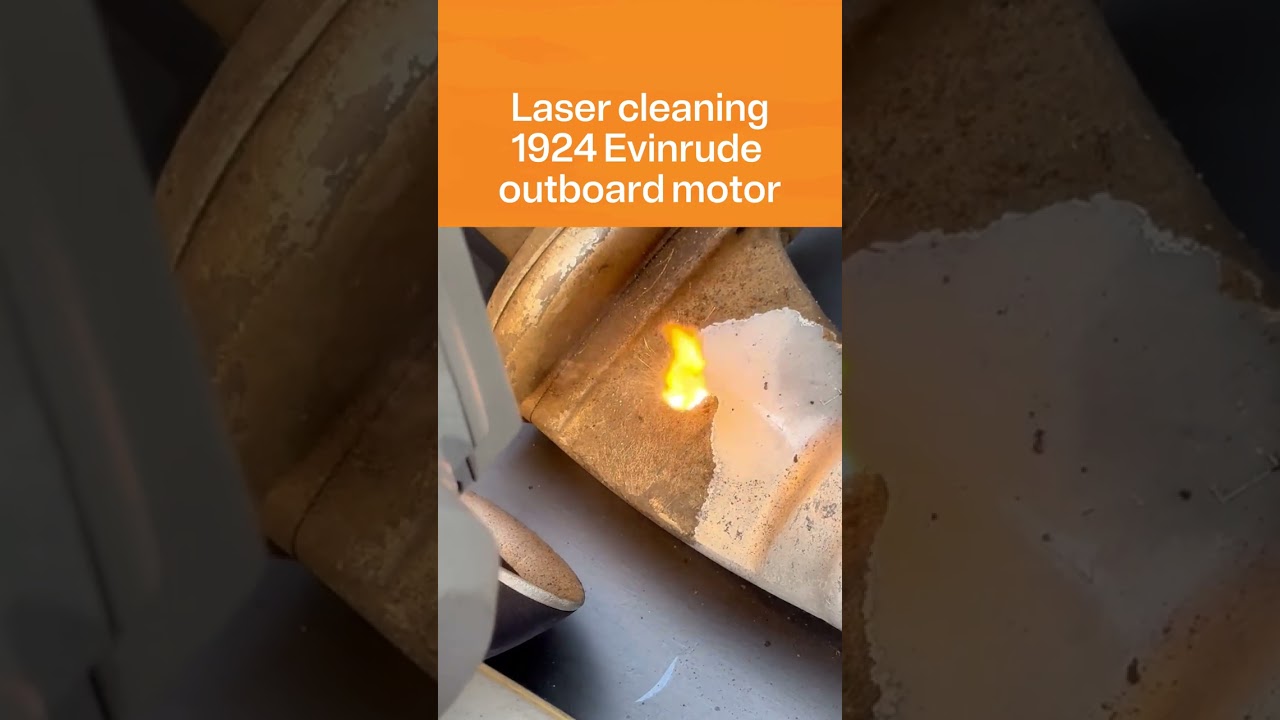
Pulsed fiber laser cleaning removes rust, old paint, and marine scale from a 1924 Evinrude outboard propeller and drive in this 38-second clip, without touching the blade edges or shaft journals. Oxidation clears from bronze blade surfaces while corrosion comes off aluminum housing sections, and the drive shaft keeps its original fit throughout. Grinding or media blasting on a period propeller risks rounding the blade profile or opening shaft tolerances, an outcome this method avoids. Marine rust removal here follows the same fluence logic used in bay area laser rust removal work, where paint and corrosion clear layer by layer instead of stripping base metal. What the footage does not show: chemical strippers, abrasive media, or reshaping of the propeller pitch. The propeller stays dimensionally unchanged after cleaning, ready for inspection rather than replacement.
Short 2wf-KGaF2pI shows pulsed laser clearing marine soil from a 1924 Evinrude propeller and drive without grit.
Laser cleaning removes scale, heat discoloration, and shop residue from 304 stainless tanks, sinks, and fabricated equipment without disturbing the passive chromium oxide layer und...

Outdoor sculpture and marine hardware in bronze can lose corrosion and later coatings with a dry laser pass when the grade is known and copper-bearing dust is captured at the head....
Anneal and service heat grow a bonded oxide scale on [steel](/materials/steel-laser-cleaning), [stainless steel](/materials/stainless-steel-laser-cleaning), titanium, and Inconel that pulsed light separates through thermal expansion mismatch rather than grinding or acid pickling. What matters is each metal's own melt ceiling, chromium-bearing dust on stainless and Inconel, and a coupon-proven setting before the production part. Clearing scale is not the same as restoring corrosion resistance.
Cured paint and powder films leave [steel](/materials/steel-laser-cleaning) and [aluminum](/materials/aluminum-laser-cleaning) hosts once a pulsed beam reaches the pigment's own breakdown point instead of chasing the metal or wood underneath. What matters is naming the pigment chemistry before the pass, capturing lead- or chromate-bearing dust the moment it forms, and proving the exact setting on a labeled coupon rather than trusting one universal recipe. A shop that skips either the chemistry check or the coupon walk risks leftover binder on one host or a scorched surface on the next.
Workpiece metal that pressure-welds onto a [tool steel](/materials/tool-steel-laser-cleaning) rake or a [carbide](/materials/tungsten-carbide-laser-cleaning) cutting edge comes off under pulsed light so the tool can cut again. What matters is telling the deposit from the tool itself, avoiding a nicked edge, and capturing metal dust as it leaves. Prove the pass on a spare tool first because the deposit and the host can share the same color and the same base metal.
Black crust and carbon film on [marble](/materials/marble-laser-cleaning) and [limestone](/materials/limestone-laser-cleaning) come off under pulsed light once the soil absorbs far more energy than the pale stone it sits on. What decides the outcome is telling gypsum crust from a thin soot film or a living biofilm, treating sandstone as its own coupon job because its safe margin runs a fraction of marble's, and capturing the crust dust so it does not resettle on the scaffold.
Copper oxide films come off under pulsed light when the job calls for bright [copper](/materials/copper-laser-cleaning) rather than a kept patina. What matters is stopping before the beam cuts into the copper, capturing the oxide fume, and proving the land on scrap because a wanted patina and an unwanted tarnish need different end points.

Precision surface work requires contact-free cleaning because gauge faces, optical flats, and polished tooling scratch under abrasive pads or chemical baths. Pulsed fiber sources r...

Landmark facade work requires a hidden test patch before pulsed laser cleaning touches any visible elevation. The pass removes soot, pollution crust, and graffiti from [brick](/mat...
